Companion exhibition Chicago’s Living Habitat with co-curator Openlands orients visitors to the natural landscapes of the Chicago region
FOR IMMEDIATE RELEASE
Media Contacts
Rob Walton | Chicago Architecture Center
E: RWalton@architecture.org | P: 312.322.1146
Jill Mediatore | Studio Gang
E: press@studiogang.com | P: 212.579.1514
Michael Kamp | Openlands
E: mkamp@openlands.org | P: 608.698.7758
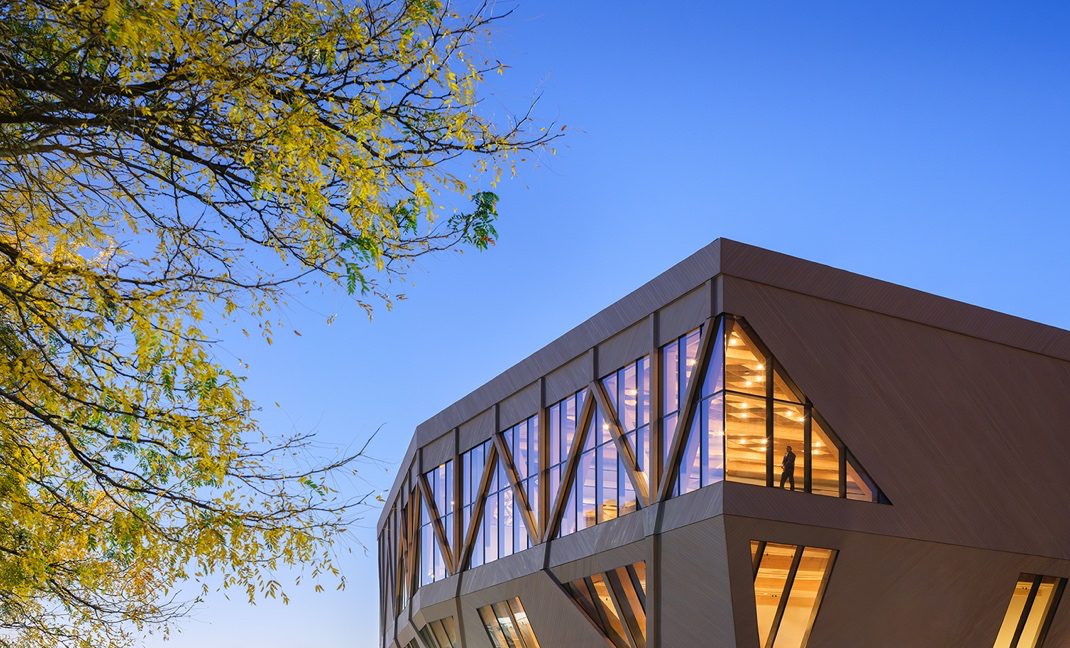
Photo: David Rubenstein Treehouse at Harvard University. Photo by Jason O’Rear, courtesy of Studio Gang.
CHICAGO (April 21, 2026) – The Chicago Architecture Center (CAC) announces two complementary exhibitions addressing the intersection of urban design and natural environments. The inspiring and revelatory new exhibition, Flyway City: Architecture for a Flourishing Ecosystem, designed and co-curated by Studio Gang – the architecture and urban design practice founded in Chicago and led by world-renowned architect Jeanne Gang – in collaboration with the Chicago Architecture Center, aims to catalyze positive change on making cities safer and more welcoming for birds and diverse wildlife. The exhibition reveals how people can take scalable action to create healthier urban habitats and save birds from colliding with building glass – a problem that currently kills more than 1 billion birds each year in the United States.
Upon entry to the exhibition galleries, visitors will experience Chicago’s Living Habitat, a companion exhibition co-curated with conservation organization Openlands. This exhibition introduces visitors to five distinct ecosystems of the Chicago region – wetland, prairie, dunes and swales, woodland and urban wildlife – to ground visitors in the stunning diversity of the broader Chicagoland region where so many species, including humans, have made their homes. Flyway City and Chicago’s Living Habitat open June 11, 2026 at the Chicago Architecture Center, 111 E Wacker Drive.
“These exhibitions can engage the hearts and minds of the public to imagine how cities can be designed to support both people and wildlife,” said Eleanor Esser Gorski, AIA, CEO and President of the Chicago Architecture Center. “The objectives of these exhibitions perfectly align with CAC’s mission to inspire better living through design.”
About Flyway City: Architecture for a Flourishing Ecosystem
Chicagoland is a living habitat home to diverse people, animals and plants. An especially attractive habitat for wild birds, the region hosts millions of avian visitors each spring and fall as they fly along the Mississippi Flyway, a major migration route that spans from Canada to South America. While their migratory journey is regarded by many as a natural wonder, birds often collide with glass — a material they cannot see — used in buildings from single-story homes to skyscrapers. Chicago poses a particular danger to birds because of the city’s location on the Mississippi Flyway and its prevalent use of glass as a building material, presenting an opportunity to explore effective approaches to creating a bird-safe built environment that also inspires design creativity and innovative urban development. These approaches range from making simple updates to the windows of homes and workplaces, to designing new bird-friendly buildings, to advocating for policy change.
“Bird-safe design is a critical issue that my team and I have been working on for more than 20 years. We’re delighted to collaborate with the Chicago Architecture Center on this new exhibition that’s designed to expand public awareness and spark positive action in our home city of Chicago. With our location on the Mississippi Flyway, Chicago is a critical stop for many migratory birds. It’s a wonderful opportunity to observe nature in our city and we have a responsibility to better protect birds from colliding with buildings,” said Jeanne Gang, FAIA, Founding Partner of Studio Gang. “I hope Flyway City inspires a new class of bird-safe design advocates and helps our city advance its legacy of innovative architecture.”
Flyway City features a selection of Studio Gang projects, including the iconic Aqua Tower in downtown Chicago and more recent work such as the David Rubenstein Treehouse at Harvard University, that offer bird-safe design strategies. On view will be architectural models and mock-ups, original illustrations, photography, building materials, and interactive media, along with bird-related artifacts from local Chicago organizations and individuals.
Supported by scientific research and Chicago’s thriving community of bird advocates and enthusiasts, Flyway City invites everyone to take part in making Chicago a flourishing ecosystem for all.
Flyway City runs through January 2027 at the Chicago Architecture Center.
About Chicago’s Living Habitat
Chicago’s Living Habitat invites visitors to experience the landscapes that sustain life across our region — and to see their role in shaping its future.
“Chicago is easy to think of as a city of buildings, but it sits within one of the most important ecological regions in North America,” said Michael S. Davidson, President and CEO of Openlands. “The same landscapes that support millions of migrating birds also shape the health and resilience of our communities. This exhibition is about making that connection visible, and about the choices in front of us right now. Partnering with the Chicago Architecture Center and Studio Gang allows us to tell a more complete story: not just how we design our city, but the living system that makes that design possible.”
Through immersive photography and clear, accessible storytelling, the exhibition reveals the diversity of landscapes that define the greater Chicago region. From the dunes along Lake Michigan to prairies, wetlands, woodlands and urban green spaces, these environments support remarkable biodiversity alongside nearly 10 million residents and one of the world’s largest freshwater systems.
This is a story of people and nature. Visitors will come to understand that the health of these landscapes is the result of decades of decisions — what has been protected, what has been lost and what is now being restored and created. Today, only a small portion of the region remains protected, placing greater importance on how we invest in and care for the land going forward.
The exhibition brings this to life through real places across the region. Some are rare remnants that have never been significantly altered, such as Goose Lake Prairie. Others demonstrate how landscapes can be restored at scale, including Midewin National Tallgrass Prairie — once a munitions facility, now one of the largest prairie restoration projects in the country. Visitors will also encounter sites like Montrose Point Bird Sanctuary, Indiana Dunes National Park and Hackmatack National Wildlife Refuge, each illustrating a different approach to conservation and stewardship.
Together, these places tell a larger story: that the built environment exists within a living system, and that system still shapes our lives every day.
Chicago’s Living Habitat is presented in partnership with the Chicago Architecture Center and Studio Gang, connecting the design of our cities with the landscapes that make them possible.
Flyway City: Architecture for a Flourishing Ecosystem
June 11, 2026 – January 2027
The Chicago Architecture Center Skyscraper Gallery
111 E Wacker Drive, Chicago
312.922.3432
Gallery admission is included with Chicago Architecture Center admission.
www.architecture.org/flyway
Chicago’s Living Habitat
June 11, 2026 – January 2027
The Chicago Architecture Center Usher Lambe Gallery
111 E Wacker Drive, Chicago
312.922.3432
Gallery admission is included with Chicago Architecture Center admission.
www.architecture.org/living-habitat
###
About Studio Gang
Studio Gang is an internationally recognized architecture and urban design practice founded and led by MacArthur Fellow Jeanne Gang. Based in Chicago with offices in New York, San Francisco and Paris, the Studio works as a collective of over 100 architects, designers and planners that use an iterative, research-based design process to create places that strengthen relationships between people, communities and the natural world.
Studio Gang’s diverse, award-winning portfolio includes cultural centers, public spaces, high-rise towers and strategic framework plans. Notable among these are the Richard Gilder Center for Science, Education, and Innovation at the American Museum of Natural History in New York; the reimagined Arkansas Museum of Fine Arts in Little Rock; the University of Chicago John W. Boyer Center in Paris; and the David Rubenstein Treehouse, Harvard University’s first mass timber building.
In addition, Studio Gang is currently designing cultural, civic and educational projects across Europe and the Americas, including the new United States Embassy in Brasília and an expansion of the Clinton Presidential Center in Little Rock.
Studio Gang also develops research, publications and exhibitions that push design’s ability to create public awareness and give rise to change — a practice the Studio calls “actionable idealism.” The office’s most recent exhibition project is The Living Orders of Venice, an original contribution to the 2025 Venice Architecture Biennale about wildlife-adaptive architecture, which is currently on view at the American Academy in Rome.
The Studio has been honored with numerous awards, including AIA California’s 2025 Firm of the Year, Dezeen Jobs’ Top Companies and Fast Company’s Most Innovative Company in Architecture.
About Openlands
Founded in 1963, Openlands protects the natural and open spaces of northeastern Illinois and the surrounding region to ensure cleaner air and water, protect natural habitats and wildlife, and help balance and enrich our lives. Openlands works across areas to advance nature-based solutions to climate change, improve the health and well-being of communities, and create a more verdant region for all.
Our 2026–2030 strategy doubles down on where Openlands leads best: our unwavering focus on land. Over the next five years, we will ground our work in land as the foundation of a connected and resilient region for people and wildlife. For more information, please visit www.openlands.org
About the Chicago Architecture Center
The Chicago Architecture Center (CAC), a nonprofit celebrating its 60th anniversary in 2026, is dedicated to inspiring people to discover why design matters. A national leader in architecture and design education, the CAC offers tours, programs, exhibitions and more that are part of a dynamic journey of lifelong learning.
Its riverfront location is in the heart of the city, where Michigan Avenue meets the Chicago River, featuring nearly 10,000 square feet of exhibition space with views of a century of iconic skyscrapers.
The Center’s Civic & Industry initiatives bring together residents, architects, policymakers and business leaders to shape a more equitable and well-designed city. Through a dynamic portfolio of in-school partnerships, out-of-school learning experiences, teacher professional development and community-based festivals including the annual Open House Chicago, the CAC Learning team engages more than 50,000 participants annually. This collective reach includes K–12 students, educators, families, professionals and lifelong learners, reflecting a comprehensive approach to education across age groups and settings. Committed to expanding access and representation in construction, engineering and design professions, the CAC offers many programs at no cost. CAC programs for architecture and design professionals, enthusiasts and CAC members include talks with acclaimed authors and practicing architects, in-depth presentations on issues and trends in urbanism and classes unlocking subjects related to the built environment.
Proceeds from programs, tours and the CAC Design Store, as well as from grants, sponsorships and donations, support its educational mission. Visit architecture.org to learn more and follow @chiarchitecture and #chiarchitecture on social media.