
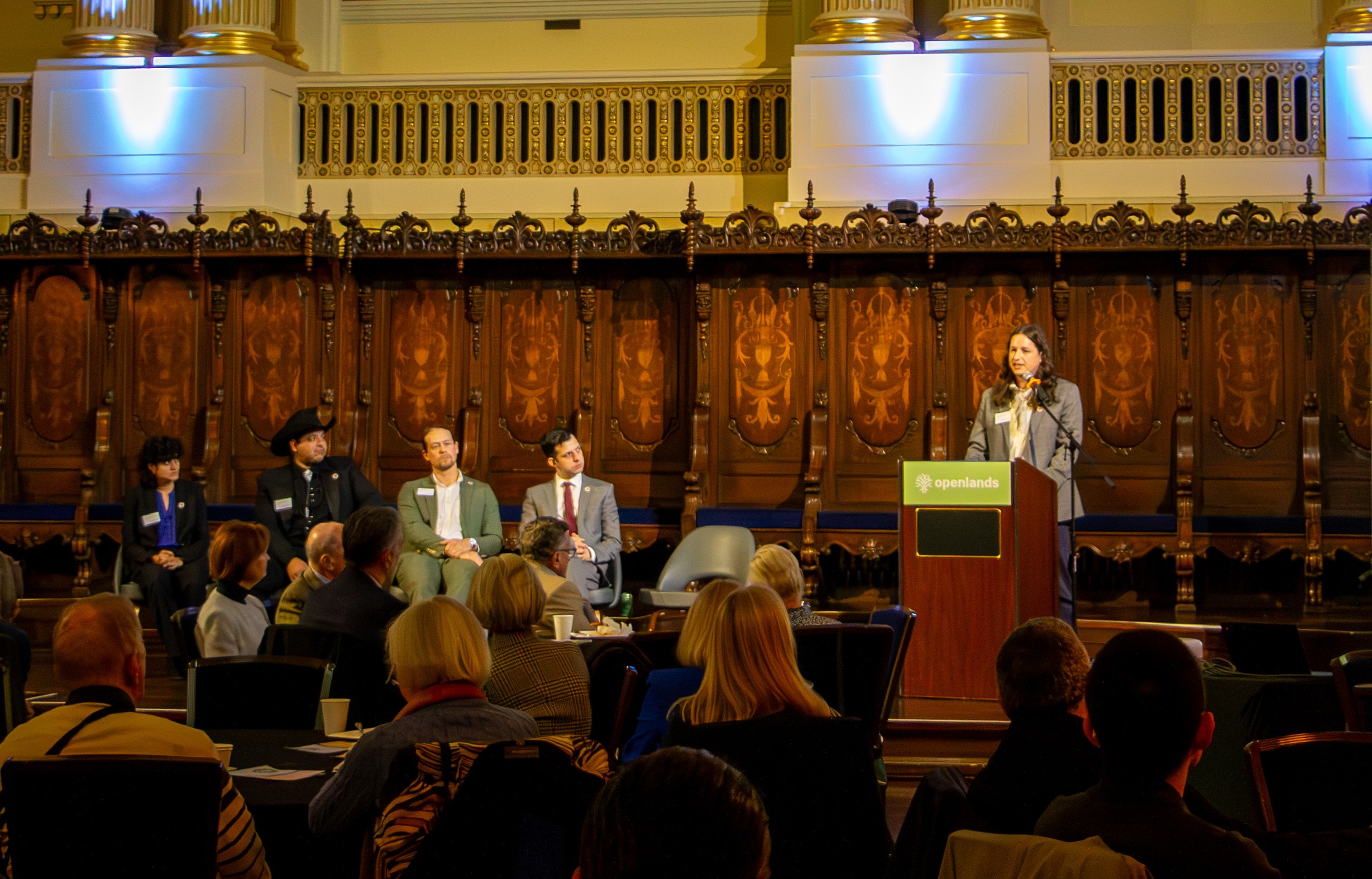
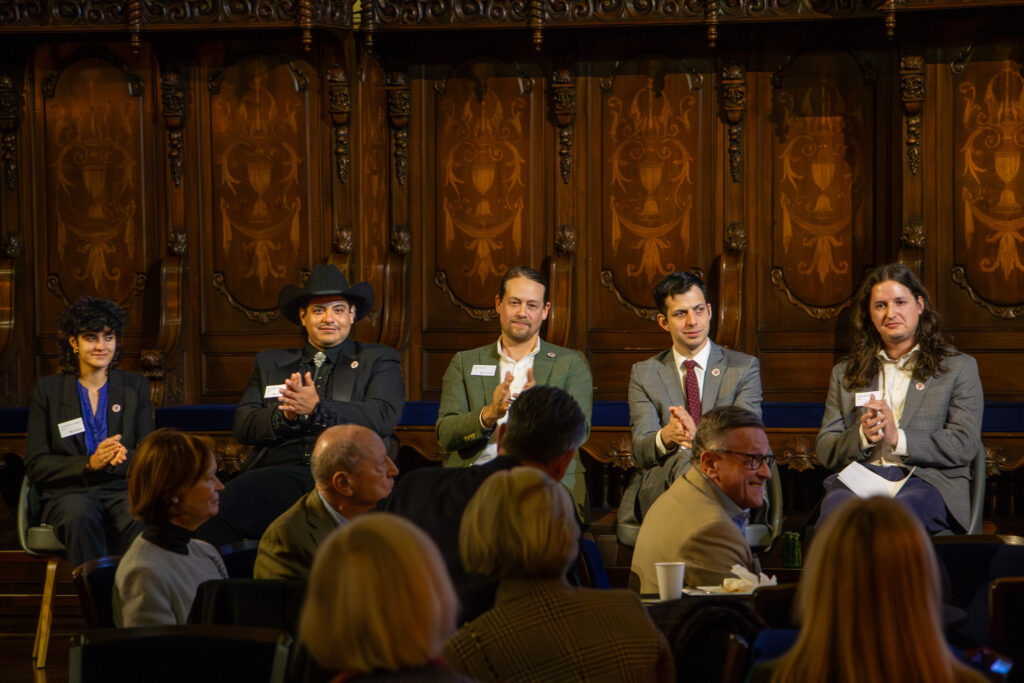
Openlands hosted Opentalks in May 2026 at The Driehaus Museum in downtown Chicago. The event aimed to deepen our supporters’ connection to our local environmental efforts through behind-the-scenes stories shared by our dedicated team of conservation experts. The following is one of those stories.
“Hi everyone, I’m Chris Bourbois and I am the Restoration Coordinator at Openlands. I help plan and manage our restoration projects across the region. We work on the ground, we work with volunteers, and we manage contractors at sites including, among others, Hackmatack National Wildlife Refuge in McHenry County, at some of our conservation easements in Lake County, at forest preserve sites across cook county, and at Midewin National Tallgrass Prairie in Will County, just SW of Joliet. That will be the setting of the story I am going to tell. It is the story of our project to help an important species, which will also hopefully help many more.
The walls are closing in… for this Upland Sandpiper.
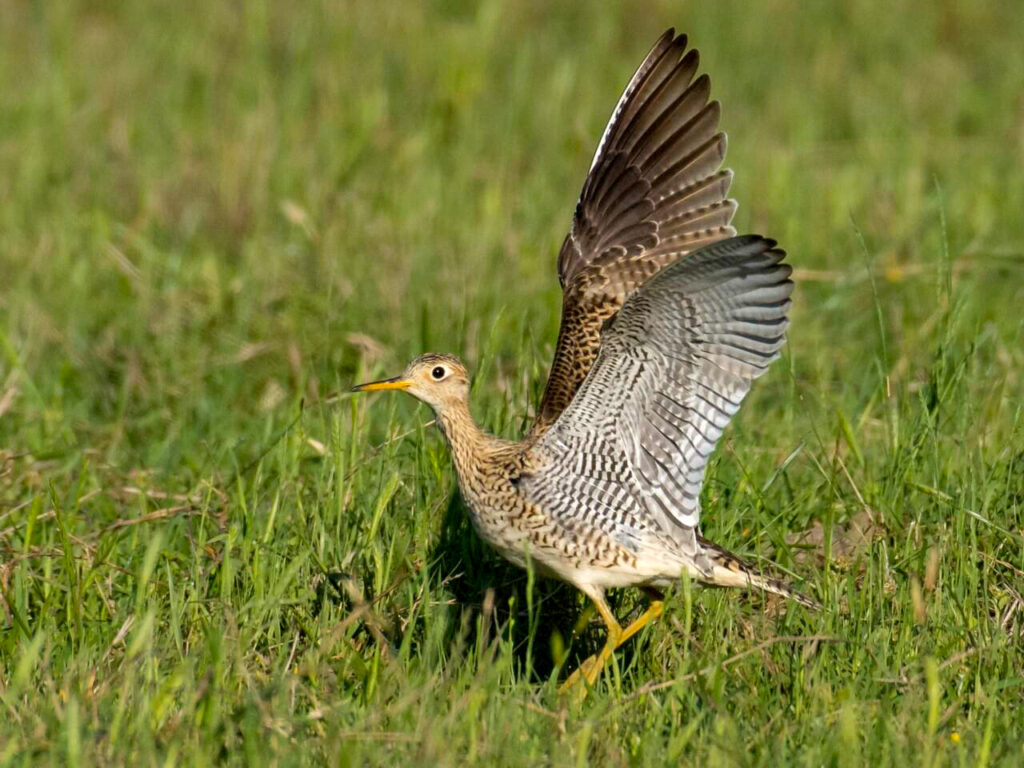
Just a few weeks ago this bird was overwintering in Argentina. As the days warmed, an environmental instinct developed over thousands of years signaled it was time to head north, alongside the many other species that make up the great web of biodiversity. Every year they return, without fail, to slot into their vital portion of a dizzyingly complex ecosystem that could fall out of balance without them. While this was always a long and arduous journey, it used to be overflowing with potential endpoints, with plenty of niches for each of the many migratory species to return to.
Yet over roughly the last hundred years, just a slim sliver of this species’ history, space is becoming hard to find. One generation watched their favorite nesting site become a sea of corn. The next saw their spots swallowed up by roads, cul de sacs, and subdivisions. Even more recently, another generation has returned to find gigantic warehouses covering their historic nesting ground.
“[Their migration] used to be overflowing with potential endpoints, with plenty of niches for each of the many migratory species to return to. Yet over roughly the last hundred years, just a slim sliver of this species’ history, space is becoming hard to find.”
One site, in the midst of high voltage powerlines and decommissioned bunkers and munitions production has become a refuge, as its unusual situation has led, in an almost accidental way, to the preservation of the open grasslands these birds need. That site is Midewin, the nation’s first national tallgrass prairie; a designation which Openlands was instrumental in advocating for. But even here, the walls are closing in. Every year, this solitary refuge feels smaller and smaller. The trees, which millions of years of evolution have taught the Upland Sandpiper to fear, filled as they are with their predators, are encroaching further and further on this sanctuary. A number of invasive tree and brush species, like Osage Orange, brought from the south and planted by farmers as hedgerows, and Autumn Olive, brought from east Asia and planted as landscaping privacy fences, proliferate at incredible rates. The remnants of the same processes that boxed the Sandpiper into this site now box them in at this site.
That’s why we are proud to highlight our National Fish and Wildlife Foundation funded project to clear 1300 acres of habitat of the invasive trees and shrubs threatening this important open grassland, an ecosystem formerly kept free of trees and shrubs by the fire and large herds of grazers we lack today. Openlands and our partners The Wetlands Initiative and The Forest Service will be returning the site to its historic wetland and open grassland complex in what is currently the largest restoration project in the region.
We will use the very same invasive trees choking out the grassland to reverse the erosion of the creek on site and bring back the wetlands historically there. We plan to seed and restore this area with native plants that support grassland birds, like Little Bluestem and Prairie Dropseed, monitoring how these birds respond the whole way. This work starts from the ground up, focusing on the structure of the ecosystem and the quality of the hydrology on site, growing in complexity and specificity as the project progresses.
“Here we are now, cutting down invasive trees so that more state endangered birds can eat more, other, state endangered birds. In the same way we came together to fight for a greater cause in the past, we ask that you join us to fight to preserve biodiversity.”
But why do we do all this work for these small, brown, sometimes unassuming birds? Personally, I think every species is worth saving. I often spent my days as a kid flipping through booklets and binders filled with pictures and facts about all the species of the world. I wanted to save each and every one, the rhinos and elephants of Africa, just as much as the birds and frogs and snakes I ran around looking for in the drainage ditch behind my house growing up.
It should come as no surprise that this frequently feels impossible, a Sisyphean task that always feels like one step forward and two back. But perhaps even more futile is to expect the unbelievably entangled web of biodiversity to withstand its strings being pulled apart as we perch delicately atop it. We can’t sit idly by, watching as this Jenga tower has its blocks removed at an ever-increasing pace, because we can’t know which removal will induce a collapse.
As Aldo Leopold said “If the biota, in the course of aeons, has built something we like but do not understand, then who but a fool would discard seemingly useless parts? To keep every cog and wheel is the first precaution of intelligent tinkering.”
“We can’t sit idly by, watching as this Jenga tower has its blocks removed at an ever-increasing pace, because we can’t know which removal will induce a collapse.”
This brings me back to a scene observed by Bill Glass, a former ecologist at Midewin: “Behind the tall, guarded chain-link fence, under the buzzing, 100-feet-tall power lines, surrounded by the remnants of a grand effort to fight a war that has been over for 50 years, is a Northern Harrier preying on an Upland Sandpiper. One state endangered bird eating another, so in a paradoxical way, success.“
Here we are now, cutting down invasive trees so that more state endangered birds can eat more, other, state endangered birds. In the same way we came together to fight for a greater cause in the past, we ask that you join us to fight to preserve biodiversity. It is what we must do when we recognize that our greatest strength is our diversity: make our best effort to preserve every strand of the great web of life.”
You can contact Chris at cbourbois@openlands.org