
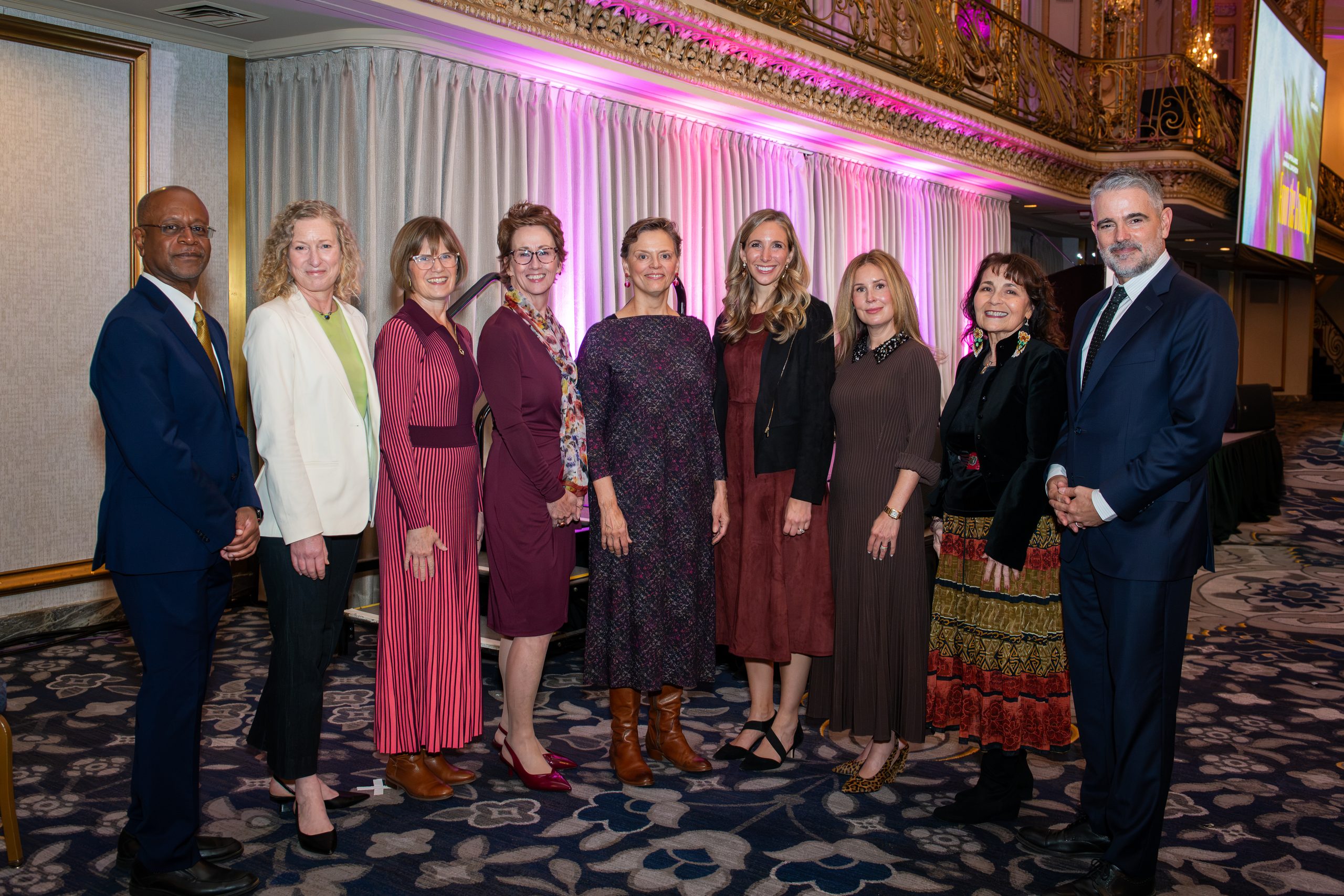
Featuring Dr. Tessa Francis as the keynote speaker, a poetry reading by Kimberly Blaeser, and honoring Jean M. Franczyk as the Gerald W. Adelmann Conservation Leadership Award recipient
FOR IMMEDIATE RELEASE
Media Contacts
Claudia Latapí, Assistant Director of Communications
clatapi@openlands.org
(734) 881- 4795
Michael Kamp, Public Relations Specialist
mkamp@openlands.org
(312) 863-6250 ext. 6301
CHICAGO,IL – (October 26, 2026) Openlands, a prominent conservation organization working in the Chicago region, hosted the 2026 Annual Luncheon on Wednesday, October 21, at the Hilton Chicago. Over 800 attendees, including environmental leaders, elected officials, and community partners, gathered for the premier conservation event of the year in Chicago. The theme, “From the Ground Up,” wove throughout the programming and reminded guests to take cues from nature and support one another.
The annual fundraiser and community building event began with a short video showcasing Openlands’ mission followed by remarks from Openlands’ President and CEO, Michael Davidson. He opened speaking about the beautiful public spaces we share, such as the lakefront and network of forest preserves. “These places don’t protect themselves, conserve themselves, or steward themselves. It takes people willing to come together, make choices, and do the literal footwork,” said Davidson. “That’s conservation from the ground up. And that’s the work of Openlands.”
Davidson highlighted people coming together for conservation across the region. At Midewin National Tallgrass Prairie, Openlands, The Wetlands Initiative, and US Forest Service are leading the largest current restoration project in northeastern Illinois. After clearing invasive trees and shrubs across 1,300 acres (about 1,000 football fields), the second phase of work will restore the natural hydrology and meandering stream in the Grant Creek watershed.
Additionally, Openlands launched the nation’s first Department of Labor approved Ecological Restoration Registered Apprenticeship. The apprenticeship brings together interested candidates, industry leaders, and college coursework to train the next generation of professionals to care for the region’s land. More partners came together for companion exhibits at the Chicago Architecture Center (CAC): Chicago’s Living Habitat and Flyway City. The former, a collaboration between Openlands and CAC, details the diverse landscapes of the Chicago region, and the latter, a collaboration between Studio Gang and CAC, covers architectural solutions to the massive problem of birds colliding with glass.
Dr. Tessa Francis, Deputy Director of The Nature Record, delivered the keynote sharing from her experience leading the effort to understand the state of nature across the United States. The Nature Record began as the National Nature Assessment, a federal initiative launched in 2022, but the federal government canceled the effort in January 2025. However, the scientists involved strongly believed in finishing what they started, and with support from private funders, the effort moved outside the federal government and is now led by The Nature Record, a nonprofit organization.
“Surprisingly, there isn’t one place you can turn to definitively, authoritatively, describe the current state of nature in the U.S., how its changing, and how it’s projected to change in the future. And so that’s where The Nature Record comes in. The Nature Record is the first of its kind, holistic assessment of the state of nature in the U.S. and its territories and its benefits to people,” said Francis.
As a unique addition, the luncheon featured a poetry reading this year. Kimberly Blaeser, founding director of Indigenous Nations Poets and past Wisconsin Poet Laureate, read three poems and invited audience participation. “My final poem recounts one of my many watery journeys, journeys always filled with wonder,” said Blaeser. This last poem, “Because we story ourselves in water,” appears in The Nature of Our Times, a poetry anthology companion to The Nature Record.
Each year at the luncheon, the Gerald W. Adelmann Conservation Leadership Award honors environmental champions whose vision and advocacy have advanced conservation, equity, and access to nature. The award especially recognizes individuals whose accomplishments advance conservation as well as strengthen their communities. Last year, Pulitzer Prize winner Blair Kamin was presented the award for his work highlighting how design and nature intersect to strengthen our connection to the land.
This year, the presentation of 2026 Gerald W. Adelmann Conservation Leadership Award to Jean M. Franczyk, past President and CEO of the Chicago Botanic Garden, closed out the programming. Franczyk led the renowned botanic garden from 2016 to 2026, overseeing an institution that welcomes 1.3 million visitors annually. During her tenure, Franczyk advanced scientific initiatives through the Negaunee Institute, including a seed bank program to protect biodiversity. Fostering community engagement was also a key focus for Franczyk, with programs like Windy City Harvest providing healthy food to Chicago residents while training future conservation leaders.
Franczyk spoke about her connection to the natural world from a young age and her mother’s directive to ‘Get Outside!’ When Openlands released the Get Outside Map online in 2019, Franczyk thought of her mother. “The truth is they were channeling parents everywhere who know viscerally that getting outside is really, really good for us,” said Franczyk. This directive stayed with Franczyk through her time at the Chicago Botanic Garden. “We succeed when our efforts are responding to a basic human desire to get outside, where people can refresh, relax, and reconnect with the natural world.”
By supporting each other, just as trees do, valuing our differences and diversity, and understanding the importance of gathering in public natural spaces, we can all protect our shared environment “From the Ground Up.” In the year between now and the next Openlands Annual Luncheon, the organization hopes that people will continue coming together to make a region where both people and nature thrive.
###
About Openlands
Founded in 1963, Openlands protects the natural and open spaces of northeastern Illinois and the surrounding region to ensure cleaner air and water, protect natural habitats and wildlife, and help balance and enrich our lives. Openlands works across areas to advance nature-based solutions to climate change, improve the health and well-being of communities, and create a more verdant region for all.