
FOR IMMEDIATE RELEASE
Media Contacts
Claudia Latapi, Assistant Director of Communications, Openlands
clatapi@openlands.org
734-881-4795
Claire Marcy, Senior Vice President, Healthy Schools Campaign
claire@healthyschoolscampaign.org
773-456-1745
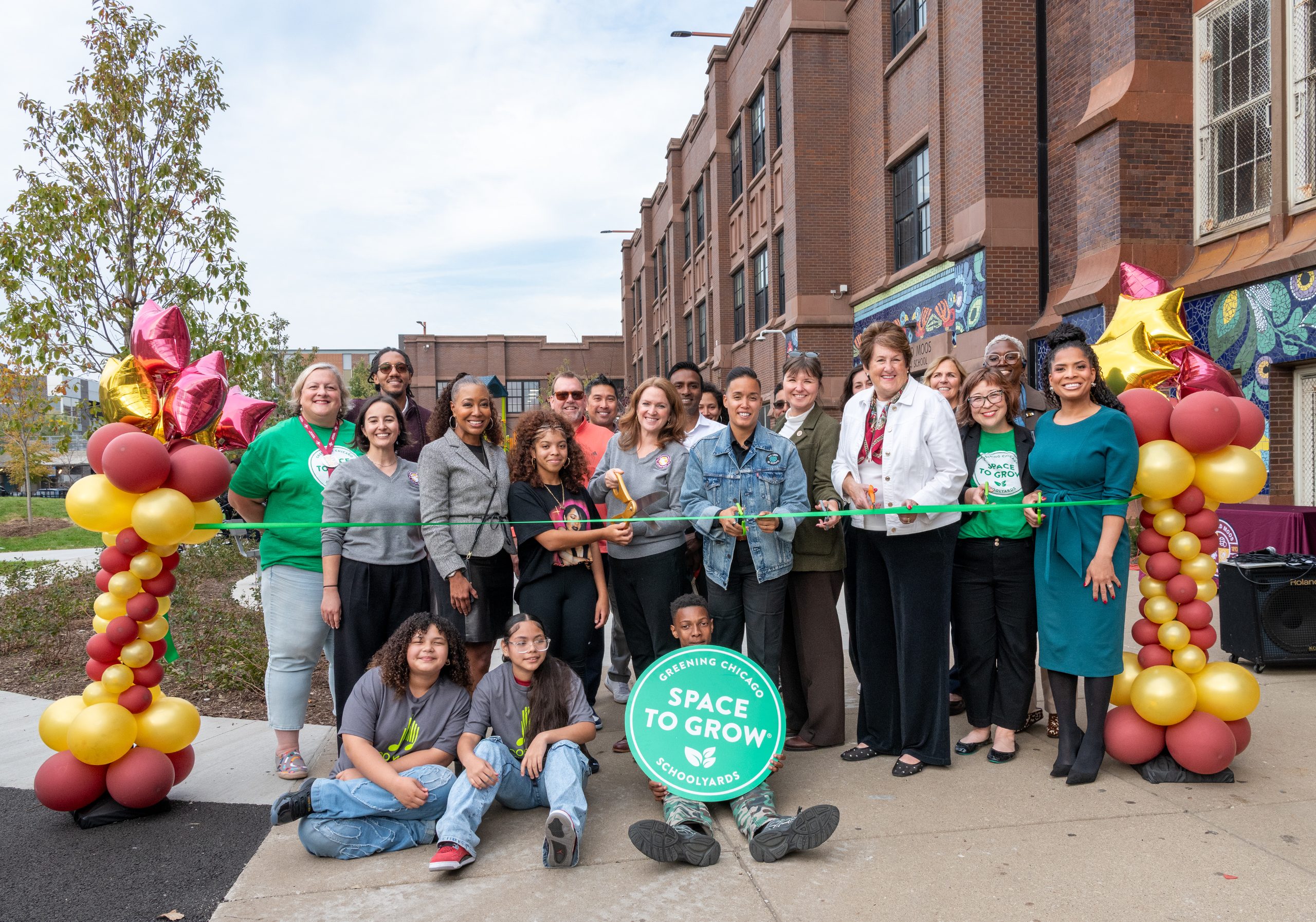
CHICAGO, IL – (November 17, 2026) This fall, Space to Grow, a partnership dedicated to transforming schoolyards into vibrant green spaces celebrated the opening of four newly redesigned schoolyards across Chicago Public Schools (CPS). The transformed schoolyards include George Washington High School, marking Space to Grow’s first high school project, and three elementary schools: Bernhard Moos Elementary School, Amelia Earhart Options for Knowledge School and Jane Addams Elementary School. With these additions, Space to Grow has redesigned 45 schoolyards since the program launched in 2013.
Space to Grow is a partnership co-founded by Healthy Schools Campaign and Openlands to transform Chicago schoolyards into vibrant spaces that support health and learning for students while bringing communities together and making neighborhoods more resilient to climate change. The program is made possible through capital funding, leadership and expertise from Chicago Public Schools, the Chicago Department of Water Management, the Chicago Department of Environment and the Metropolitan Water Reclamation District of Greater Chicago. Every Space to Grow schoolyard is designed through a participatory process that engages the whole school community through visioning sessions, surveys, community meetings and workshops.
The schoolyards, which were once mostly asphalt and compacted fields, now have native plants and trees, gardens, outdoor classrooms, athletic fields and inclusive play equipment that bring students and neighbors outside. “In all our Space to Grow schoolyards, students are staying after school longer, and families are coming back for things like outdoor movie nights. Students get a place to learn and connect, neighbors get a green space close to home, and the city gets a little more protection from flooding,” said Daniella Pereira, COO of Openlands.
“Each schoolyard started with the school community telling us what they needed and sharing their dreams for how their new schoolyard could better serve their community’s priorities,” said Jennifer Tani, President and CEO of Healthy Schools Campaign. “By shaping these spaces, students, families and neighbors took ownership and helped create healthier learning environments for students and welcoming places for their communities to gather.”
The schoolyards incorporate green infrastructure that helps manage stormwater and build climate resilience. Rain gardens, permeable surfaces, and turf fields with underground storage on site, and new trees add shade that helps cool the neighborhood. Together the 45 Space to Grow schoolyards can capture 11.2 million gallons of rainwater per rain event, which eases the load on Chicago’s sewer system and means fewer flooded streets and basements in surrounding communities.
The four new schoolyards feature a mix of green space, recreation and outdoor learning opportunities, with each reflecting the priorities of its school community. On Chicago’s southeast side, George Washington High School and Jane Addams Elementary School share a dual-campus schoolyard with a competition-size soccer field, an athletic court, and rain and pollinator gardens. A community mural project, led by a school alumnus, is being planned for a second phase of work. In Humboldt Park, Bernhard Moos Elementary School’s schoolyard features a turf field and track, a volleyball court, nature play, an outdoor classroom, a rain garden, vegetable garden beds and play mounds. At Amelia Earhart Options for Knowledge School, the new schoolyard includes a turf field and track, basketball court, fitness equipment, play mounds, an outdoor classroom, and native and vegetable gardens.
School communities marked the openings with performances and student remarks that reflected each school’s spirit and culture. Washington’s student band played classic rock during its celebration. At Addams, students joined Washington’s band for a special joint performance and shared remarks of their own. Moos students celebrated with bucket drumming and a cheer routine, while Earhart students welcomed their new schoolyard with West African drumming and dancing, a gospel choir performance and remarks from student leaders.
Healthy Schools Campaign and Openlands thank the public agency partners, school communities and neighbors who helped shape these spaces. Together, they represent a long-term investment in Chicago’s students, families, public schools and neighborhoods, and in a greener, healthier and more resilient city.
###
About Openlands
Founded in 1963, Openlands protects the natural and open spaces of northeastern Illinois and the surrounding region to ensure cleaner air and water, protect natural habitats and wildlife, and help balance and enrich our lives. Openlands works across areas to advance nature-based solutions to climate change, improve the health and well-being of communities, and create a more verdant region for all. For more information, please visit www.openlands.org.
About Healthy Schools Campaign
Healthy Schools Campaign is a nonprofit organization that works at the local, state and national levels to make schools healthier places where children can learn and thrive. At the intersection of health, education, equity and sustainability, HSC advances programs and policies that support student health and well-being, with a focus on under-invested schools and the communities they serve. For more information, please visit healthyschoolscampaign.org.